
Albus
Your next cloud workspace
Description
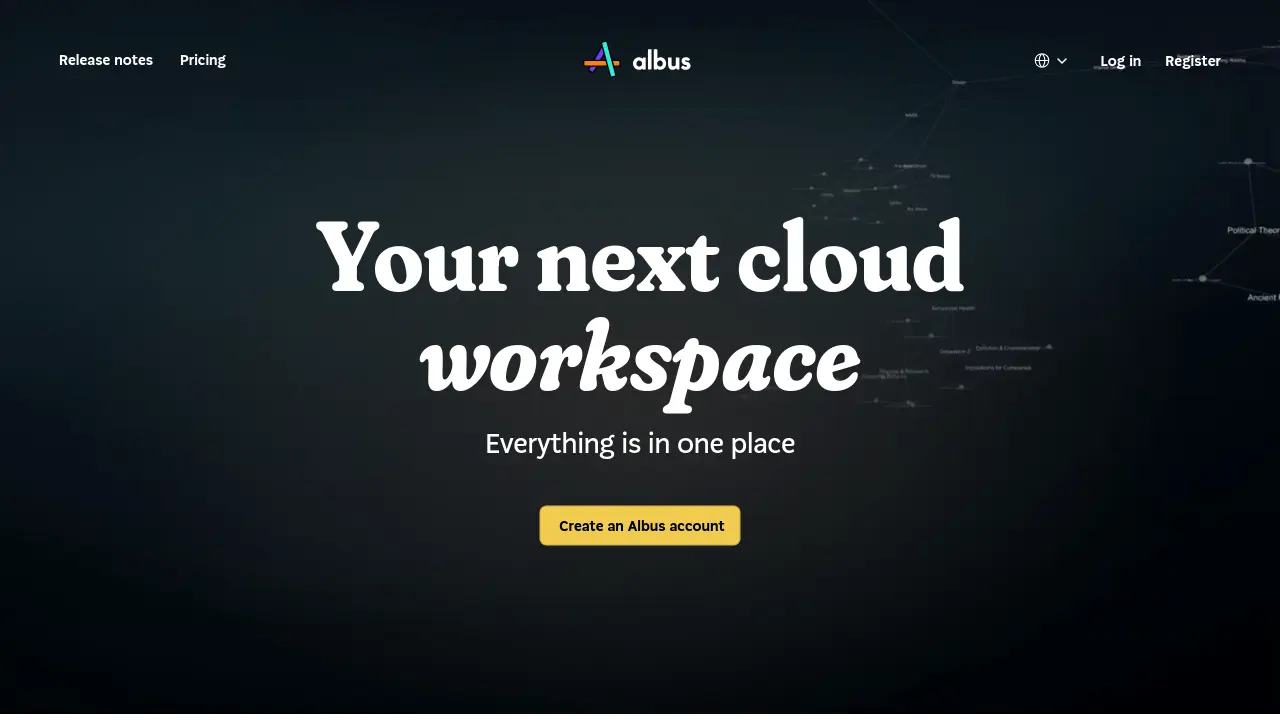
Albus introduces an intelligent cloud workspace designed to streamline how users manage and interact with their digital files. Leveraging a core semantic indexing engine, Albus automatically organizes various file types, including PDFs, audio files, images, text documents, and web articles, into logical categories without requiring manual folder creation. This semantic understanding allows users to perform searches across their entire library based on meaning, not just keywords.
The platform enables users to ask questions and receive answers directly sourced from their uploaded content, complete with references to specific pages or sections. Beyond file management and search, Albus incorporates multi-functional AI capabilities, including access to the live web for up-to-date information, conversation and canvas modes for interaction, image generation using models like DALL-E 3 and Google Imagen 3, and both standard and life-like audio narration features.
Key Features
- Semantic Indexing Engine: Automatically organizes diverse file types based on content understanding.
- Multi-modal File Processing: Supports PDFs, audio, images, text files, and web articles.
- Semantic Search: Search across the entire library based on meaning and context.
- Referenced Answers: Provides AI-generated answers sourced directly from user documents with citations.
- Live Web Access: Integrates real-time web search into its conversational capabilities.
- Multi-AI Model Access: Utilizes various advanced AI models (GPT-4o, Gemini 1.5 Pro, Claude 3.5 Sonnet, etc.).
- Image Generation: Creates images using Google Imagen 3, DALL-E 3, and Flux models.
- Audio Narration: Offers standard and life-like text-to-speech generation (powered by ElevenLabs).
- Automatic Folder Structuring: Reorganize file structures with a single command.
- Canvas Mode: Provides a visual workspace environment (details inferred from pricing tier).
Use Cases
- Automating the organization of large document libraries.
- Building personal or team knowledge bases from diverse sources.
- Conducting research by querying personal document collections.
- Quickly finding specific information within various file types.
- Generating images for projects or content.
- Creating audio narrations for presentations or accessibility.
- Streamlining study of complex topics using personal resources.
- Transcribing audio files.
You Might Also Like

Blir.AI
FreemiumRemove, replace, or generate backgrounds for your online store in seconds

Lucas
Usage BasedYour all-in-one AI video solution

Santelmo Music
Pay OncePersonalized AI Music Production and Audio Services

omni:us Digital Claims Adjuster
Contact for PricingAI-Powered End-2-End Claim Automation for Insurers

RapL AI
Free TrialBoost employee performance through Data and AI