
upstream
AI-powered feature flags with real-time rollouts and automated rollback.
Description
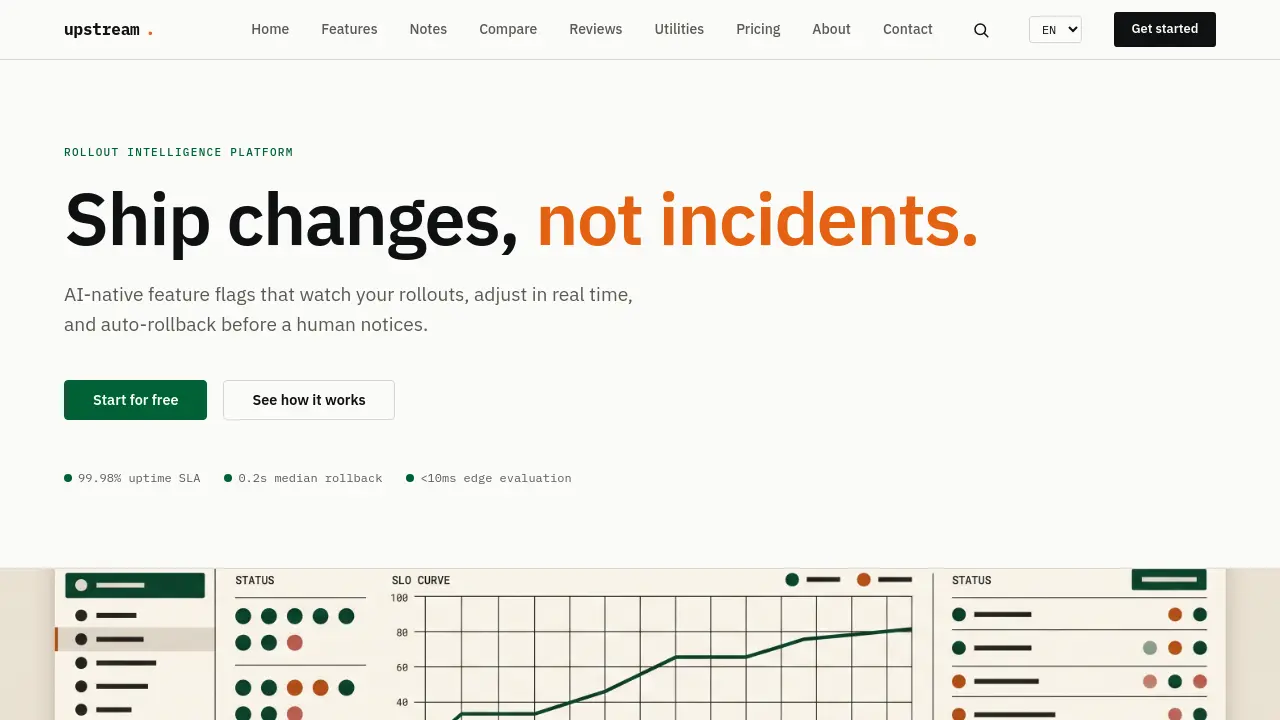
upstream is an advanced platform for managing feature rollouts with AI-driven intelligence. It automatically monitors rollout health in real time, evaluating metrics like error rates, latency, and conversion across your environments. With its edge-optimized SDK and robust API, upstream enables near-instantaneous flag evaluation and provides rapid, automatic rollback to ensure stability before issues affect your users.
Designed for reliability and ease of use, upstream supports dynamic configuration, automated documentation, and natural language flag querying, all without requiring constant oversight or manual intervention. Its transparent pricing and scalable plans make it suitable for both small projects and large enterprises focused on safe, efficient deployments.
Key Features
- Edge SDK Evaluation: Feature flags are evaluated at the edge in under 10ms for minimal latency.
- AI-Powered Monitoring: Continuously tracks error rates, latency, and conversion metrics to make rollout decisions.
- Automatic Rollback: Detects anomalies and performs median 0.2s rollback, preemptively safeguarding users.
- Dynamic Configuration API: Core REST API supports flags, environments, audience targeting, and percentage rollouts.
- AI Rollout Pilot: Automatically ramps up, pauses, or rolls back based on customizable SLOs.
- Anomaly Guard: Real-time anomaly detection on business and technical signals with severity-based action.
- Codebase Intelligence: Introspects code, maps flag usage, identifies dead flags, auto-generates documentation.
- Config Copilot: Natural language interface to query flag status and perform quick actions.
- Multi-environment Support: Enables consistent flag management across various deployment environments.
- Seamless Integrations: Slack, Linear, and GitHub integrations for streamlined notifications and workflows.
Use Cases
- Safely releasing new software features
- Automated rollback in case of incidents
- Minimizing downtime during deployments
- Managing feature rollouts across multiple environments
- Transitioning from legacy feature flag solutions
- Continuous monitoring of feature health metrics
- Maintaining compliance with audit-ready logs and infrastructure
- Reducing manual SRE and on-call workload
Frequently Asked Questions
How does AI Rollout Pilot decide when to ramp up or pause a feature rollout?
You define SLO targets such as error rate, p95 latency, and conversion. Upstream evaluates these metrics over a rolling window and advances the rollout percentage only when all targets are met. If any signal degrades, it automatically pauses and sends an alert.
How fast is an automatic rollback using Upstream?
The platform has a median rollback time of 0.2 seconds. Its Anomaly Guard runs at one-second intervals, with rollback operations completed fully synchronously at the edge to protect users rapidly.
Can I migrate my existing feature flags from another provider?
Yes, Upstream provides migration importers for LaunchDarkly, Split.io, and Statsig JSON exports, retaining targeting rules and supporting parallel runs during your transition.
What happens if Upstream goes down during a rollout?
The SDK evaluates flags locally with a cached snapshot. If the edge cannot be reached for over 30 seconds, flags default to the last known stable state. Upstream maintains a 99.98% uptime SLA on Scale and above.
Is my flag data isolated from other customers?
Yes. Each workspace is isolated at the data layer, and Scale and Enterprise customers can opt for dedicated infrastructure with their own edge nodes and SOC2 Type II audit on request.
You Might Also Like

PaperLens
FreemiumYour AI-powered lens into research
Mindsmith
FreemiumCreate better eLearning faster

OpusClip
Freemium#1 AI Video Clipping Tool: Turn Long Videos into Viral Shorts 10x Faster
Yaler.net
Usage BasedSecure remote access to embedded devices behind firewalls and NAT.

Neova
Contact for PricingAI-Enhanced DePIN Transforming Cloud Computing