Looking Glass
Glasses-free holographic displays for immersive 3D experiences.
Description
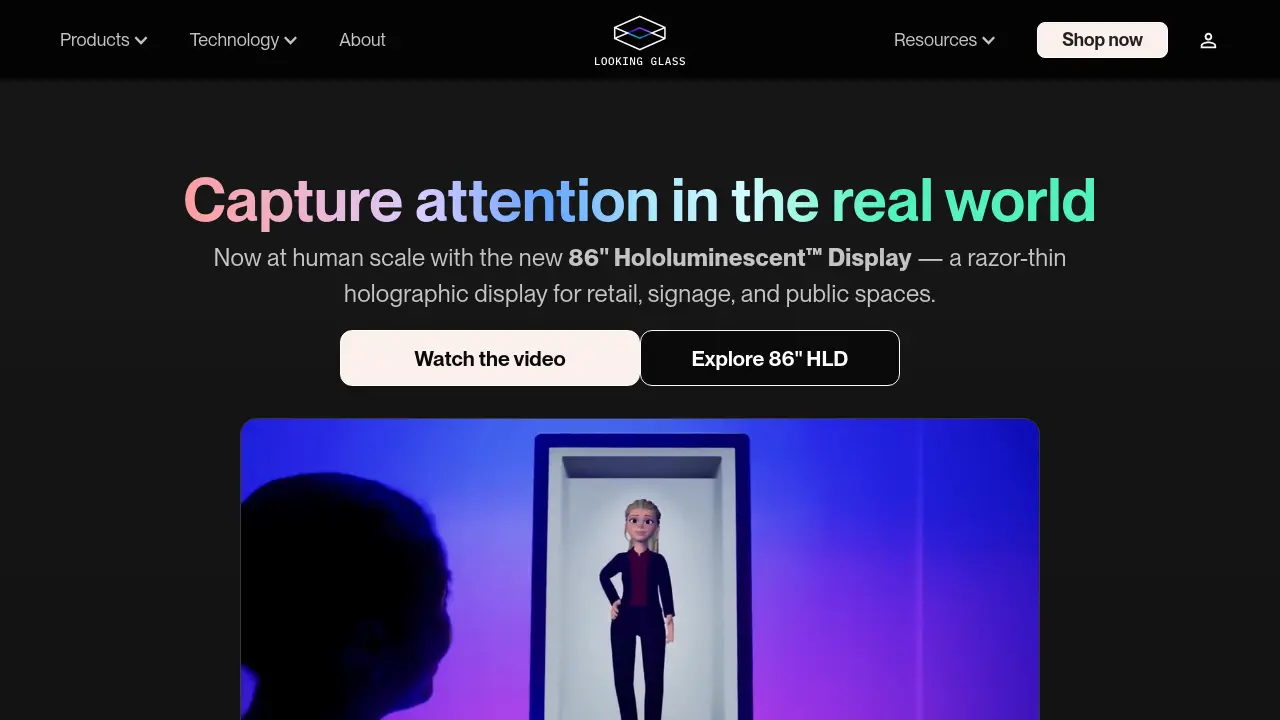
Looking Glass offers cutting-edge holographic and light field displays designed to create vivid, glasses-free 3D experiences at human scale. Their patented technology enables the transformation of standard 2D video, images, and real-time applications into dynamic, immersive visuals viewable by groups without headsets or special eyewear.
With solutions that range from compact photo frames to large-scale public signage, Looking Glass empowers brands, educators, museums, and creators to capture attention, enhance engagement, and seamlessly integrate immersive 3D content into any environment. The displays support a variety of content creation workflows and are easily deployed using familiar devices and digital signage infrastructure.
Key Features
- Hololuminescent™ Display: Converts 2D video into lifelike 3D holographic visuals
- Light Field Technology: Projects up to 100 perspectives for natural group viewing
- Glasses-Free Viewing: No headsets or special eyewear required
- Real-Time and Uploaded Content Support: Compatible with live apps, photos, and videos
- Flexible Content Creation: Integrates with Unity, Unreal, AI generators, and standard media formats
- Scalable Display Range: From portable frames to human-scale installations
- Easy Deployment: Installs like standard digital signage, supports common CMS platforms
- Multi-Platform Compatibility: Works with Windows, macOS, Raspberry Pi, and more
Use Cases
- Retail signage and product displays
- Public installations in museums and airports
- Event and trade show displays
- Education and interactive learning
- Brand activations and marketing showcases
- 3D model visualization for creators and designers
Frequently Asked Questions
What is a Hololuminescent™ Display (HLD)?
A Hololuminescent™ Display (HLD) is a patented display that embeds a holographic volume within a high-resolution screen, enabling life-like 3D visuals from standard 2D video without the need for complex 3D asset development.
Can multiple people view the 3D content at once?
Yes, Looking Glass displays are designed for group viewing, projecting dozens of perspectives so that many people can experience 3D content simultaneously and naturally, without headsets or glasses.
How do I deploy content for the displays?
Content can be loaded via USB or managed through recommended digital signage solutions like BrightSign or Yodeck. Users may also utilize the included Raspberry Pi 4 for demo purposes, and can upload content via app or web browser for compatible devices.
What types of media are supported?
Supported formats include standard 2D photos and videos (converted to 3D), 3D models in OBJ, FBX, STL, and GLB, real-time applications with Unity and Unreal, light field photos, and holographic videos created with compatible tools.
What’s the difference between HLD and Light Field Displays?
Hololuminescent Displays (HLD) are designed for effortless, high-traffic holographic presence, ideal for signage and retail, while Light Field Displays support advanced 3D visualization and interaction, catering to research, education, and industrial applications.
You Might Also Like
Typing Engine AI
FreemiumChanging the Social Media game for SMEs & Influencers

RailBird
Free TrialPoker payouts made simple

Testola
FreemiumSkill Evaluation for Top-Tier Hiring

SmartPostr
Pay OnceAI-Powered Social Media Content Creation & Scheduling

Aimour AI
FreemiumMeet Your AI Companion Today